Monday, 24 February 2014

More on Douglas

More on Douglas

Over the last few weeks I have had an enforced rest and during that time I been researching, still did ever Bosch make Douglas motorcycles under licence from 1919 to 1923. It has kept me busy reading and going over some old books like the “Best Twin” by JR Clew and, the more recent Douglas, The Complete Story by Mick Walker. I found the re-read of the Best Twin quite entertaining as there are descriptions of some of the leading lights of Douglas that are amazing Characters in themselves among them Freddie Dixon and Cyril Pullin and Walter More. There are many others who helped make the Douglas brand in trials and on the racetrack however my interest lies in the technology that went with this and during World War One Douglas was testing a leaf spring suspension frame and was in production until 1921 when it was withdrawn it possibly because there was an infringement on the Coulson B patents. In the research I found the Coulson B patents and also a reference to the Cushion Frame patented by Charles Travis in 1899. Spring frames have been around forever and a good site to look them up is at The Online Bicycle Museum. Moving on to the hey day of Douglas and 1927 and the “first” Speedway event was organised by Camberley Motorcycle Club near Camberley that was on a hard surface and a difficult track to ride around the same time Lionel Wills had seen Speedway in Australia and thought it would do well in the UK so he organised the first dirt track race at High Beach in Epping in February 1928 and at Easter there was one at Greenford Park. There is a Pathe News film of one such event. Greenford Park, not far from the Museum, was the site for horse racing that had ceased to become a “Gentlemans' Sport” and had become the Gypsy domain with horse and buggy racing. This did not go down too well with the local population and when dirt track racing arrived it was received with open arms as bringing a “Better class of people to the area” (Somewhat different from the current thinking about motorcycling). Speedway was an instant success as was the Douglas dirt track bikes based on the RA model, first used in Australia and up until the early 30's when the reign was ended by JAP engined bikes. The Douglas had been ideal having a long wheelbase and excellent handling it was the bike of choice. At the outset the art of broadsliding was new to Britain and was aptly demonstrated by a New Zealander Steven St George winning everything he entered. By the end of 1928 the Brits were getting the hang of this technique and Jack Barnett got his Douglas up the front and started winning too!


After the this golden era for Douglas finance and family problems got it the way of producing motorcycles, but that didn't stop some very interesting bikes being produced. By 1935 Douglas had come up with their first transverse flat twin, the Endeavour although not a success at the it set the trend time at what was going to happen later. Even during World War Two development did not stop even though Douglas did not produce any motorcycle, they still did other things for the war effort that included 100cc engined portable generators and pumps, some used in Halifax and Lancaster bombers as a standby power source in the event of a failure of the hydraulic system. Also the bigger engined generators that were used for portable radar equipment used on the south coast as the first line of defence and such was the reliability of those systems. Post was things looked up and Douglas had an opportunity for a military motorcycle contract. An equivalent to an ISDT held at Aldershot for Triumph, BSA and Douglas. Douglas's entry was the DV60 a 600cc transverse twin and not unlike the Endeavour, however on the day the DV60 failed as did BSA's entry leaving the Triumph the only survivor and that as the TRW! 


In the 50's Douglas's fortunes, as with many other motorcycle manufacturers, were not too good and just after their new bike the Dragonfly was introduced the official receiver came in, the company was bought by Westing House and all production ceased with any remaining motorcycles being assembled from parts by Pride and Clarke and sold on at silly low prices. This is not the end of the story Douglas Vespa come on the scene and keep Douglas in the picture for a few more years. Now it is time to read Robin Spaldings book about British Scooters!

Sunday, 19 January 2014

The Best Twin


Douglas

After last Monday at the Museum with just a few visitors that had braved the stormy weather Pete, Chris and I munched our way through the remains of the festive mince pies and chocolate coconut cheese cake that Gita was experimenting with, the next day out was Thursday. At the Wey Valley Advanced Bike club meeting on the first Sunday of the month I was asked if I could stand in and do a presentation because the arranged speaker had dropped out. I had a bit of time to do some research with a view to confirming that Bosch really had produced Douglas motorcycles for a few years after the First World War. This is a 1910 model.


The result was no more information than I had even the 2007 edition of the illustrated encyclopaedia of motorcycles by Erwin Tragatsch and that had dropped the reference that was in the 1975 edition that I have. However other information was discovered buried in the Bosch archives. This was about the relationship with Fred Simms. He was an automotive entrepreneur who sent Mr Bosch a De Dion Bouton tricycle in 1897 for his to investigate its performance. Up till then Bosch had only made a low voltage magneto that would allow engines to run at about 200 rpm. Fine for the big stationary engines but no good for a motorcycle. Bosch needed to develop a better system and the first high voltage magneto was born. In 1898 Fred Simms and Mr Bosch set up the UK distribution centre located in London. By 1902 Mr Bosch had got the high Voltage magneto working properly and had obtained the right ceramic that would stand the heat for sparking plugs and the two together made Bosch very rich. Everyone was using the magnetos and sparking plugs. Fred Simms had close contacts with Bosch but he could see there was an even better way of producing a spark so he manufactured his own motorcycle with the first proper horseshoe magnet magneto in 1903 and used it on the Clyde Motorcycle.


Sadly, the Clyde is no longer at the Museum, the motorcycle was sold by the family and we have not been able to trace where it has gone. In 1907 Mr Lucas took a fancy to the Clyde Motorcycle Company and Mr Simms sold it on. Every one was using the Bosch magneto until the out break of war. During the war Douglas motorcycles were the bike of choice. It was smooth, reliable and had good performance. Large numbers were produced and production was only second to Triumph. There were even some made in France. Post war Douglas were involved in supplying engines for light aircraft based on the 500cc ohv racing engine that produced some 20bhp at 5500rpm. The same power out put as the Triumph Ricardo of that era. Germany did not have any comparable engines at the time and even Mr Messerschmidt was at the Kingswood factory. However he ended up looking at more than engines as he married one of the daughters! By 1923 Douglas motorcycles had claimed over 200 speed and reliability records among them, in the 500cc category, nearly 100mph at Brooklands over the flying kilometre. Records for 1923 were held by Cyril Pullin and Rex Judd.


It has ben reported that Cyril got over 105 mph at Brooklands that year. Cyril Pullin was not only an expert motorcyclist, but engine tuner, pilot and aviation engineer. Also in 1923 BMW produced their first motorcycle in the R32 and the engine looked very similar to the sv Douglas of the time used in a transverse layout and may have been a direct copy. They do look similar but I can find no real evidence to support this other than the family anecdotes and Tragatsch's reference. Engine development progressed and it was not until the mid 30's that Douglas moved over to the transverse twin. The first was the Endeavour and a little later the ohv models 80 plus and 90 plus some of which my father rode as a tester in the late 40's for Douglas. More to follow as I delve deeper into the history of Douglas.

Friday, 10 January 2014

What to do when it rains!


Visit a Museum 


I tend to go find something to read but just once in a while there are more active things to do. 
Sunday I was at the Wey Valley Advanced Motorcycle club first Sunday of the month and this new year for the morning as bad weather was expected and I headed home early and spent the afternoon reviewing my London Motorcycle Museum presentation. Monday I was at the Museum and we have a new volunteer in Chris to help out. He has loaned us his Triumph Trophy and it is on display in the Home of Triumph. It rained and rained all day so I looked up more things from the Classic Motorcycle. We did have a few visitors, one from Moscow. His English and grasp of technical terms was very good. I would like to have that level of understanding in another language. Tuesday I was at the Isleworth Probus club to give a presentation about the Museum. I’d scrubbed up to look my best, suit and all for the occasion. 
They were an enthusiastic group and many recounted their own exploits on motorcycles from their youth. I didn’t need to hand around any fliers as they had already booked a visit to the Museum for Monday February 3rd.   

Wednesday was a trip out to a private collection I had been invited to while at the Off Road Bike Show in December. This was the first promised dry day for ages and I made the most of it heading out to deepest Surrey late morning. To say the least it was not a warm ride but the reception certainly made up for it. There were more than forty bikes in the collection with early AJS’s in pristine condition. In the collection are Ariels including a real red Red Hunter, a couple of Greaves and a Royal Enfield track bike that has a very short wheelbase.


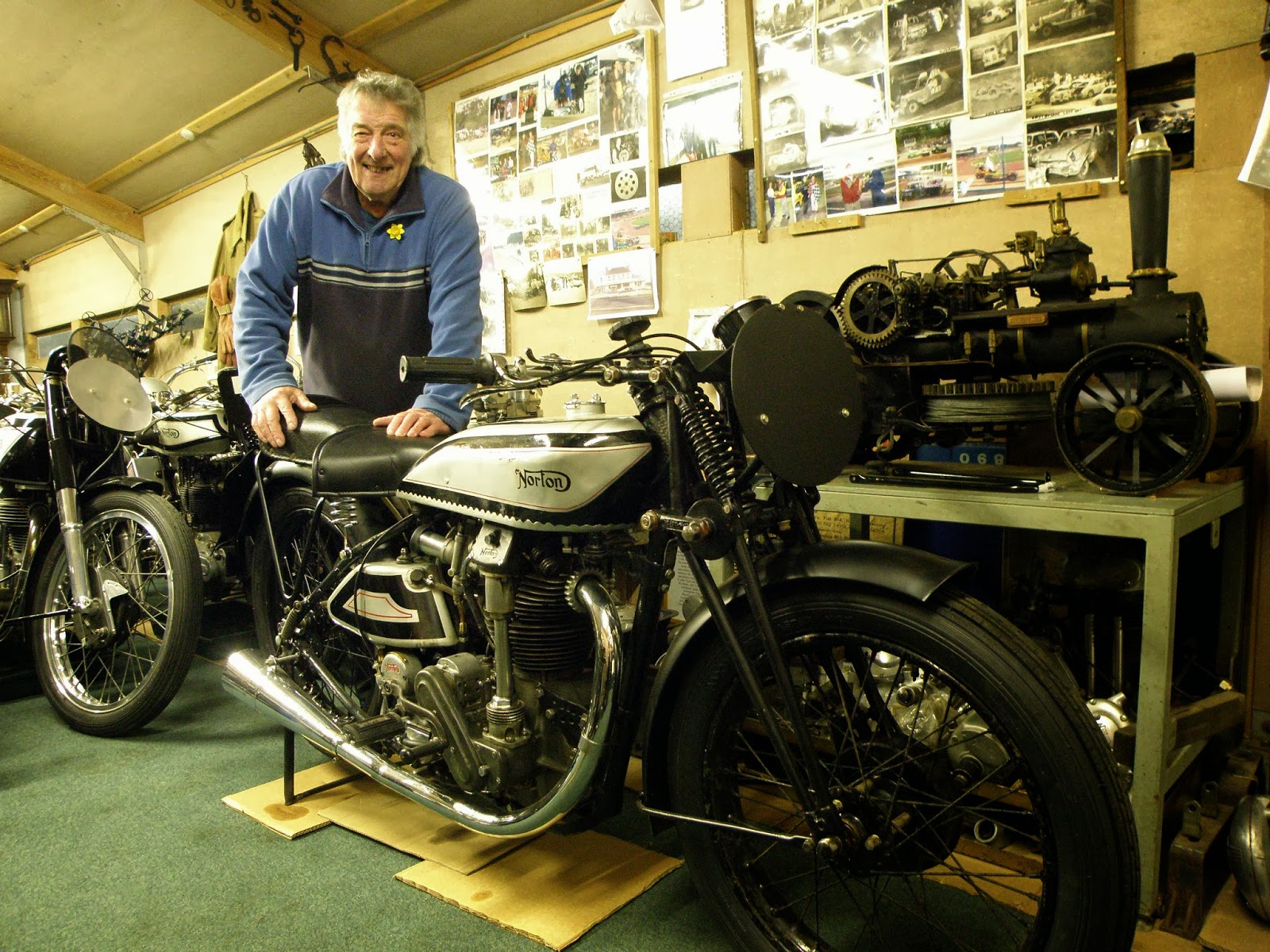
 His line up of Norton’s’ is very impressive. All of the bikes are in such good condition and roadworthy. If you would like to view his collection then contact Dave on 07836384505. He has some interesting stories to tell from his youth and still enjoys his bikes searching out and rebuilding them often making his own parts that have become impossible to find. I did like the experimental bike known as the Dunaton a classic in its own right that was drawn from 1930 parts plus a few newer ones to finish it off.


 Dave has an early Gold Star a ZB34 and a Triumph TR5 that has the same top end as the generator engine mentioned in the GP racer posting. There are bits around everywhere waiting to be used in the assembly of yet another project. His collection continues to grow. Keep an eye out for him at some of the events in Surrey as he usually rides one of his bikes to them.


Monday, 6 January 2014

The Norton 500T


Another Norton.

Another week since I was at the Museum and that was just before New Year. The weather is still inclement but it did not deter the enthusiastic. We had visitors from Norway, Switzerland and Belgium plus a few sturdy Brits who took advantage of the pound off Monday saver. Since then I have been out and about on the Kawasaki trying to avoid the rain with no trip out being completely dry and not managing to leave fliers anywhere. As to my last day at the Museum I discovered another article in the Classic Motorcycle of May 1996 about another Norton we have at the Museum. This is a 1949 500T. T is for trials although at 300lbs or 136kg it is not a lightweight but it is allot lighter than bikes of that capacity now. My Kawasaki ER6F weighs in at 407lbs or 185kg and the Buell at 462lbs or 210kg. Bikes have got allot heavier and taller.


 So this Norton had alloy head and barrel that has a cast iron liner. The rigid rear end always gives a lighter bike than one that has suspension. The low compression of 6:1 of this long stroke single assisted greatly in ensuring the engine would pull from nothing but still had enough get up and go to get around a difficult trials course for that time. These machines were campaigned successfully by such people in Irish Trials as Kevin Keegan, Chick Gibson, Bob Kenny, Mick Treacey and Sean Whyte. I have heard that even Sammy Miller had ridden one.


 The style is a winner and was displayed on the Museum stand at the Kempton Park off     Road Bike Show in December receiving an exhibitors medal. At the Museum it sits at the back of the competition display next to the Norton 650SS production racer.


There is more interesting stuff in this magazine with Mike Hodder in 1969 testing out the 100bhp Honda 4 that Mike Halewood raced and Dennis Frost talking to Peter Goodman on Velocettes, the restoration of a Gnome-Rhone and Gold Star single verses the Gold Star Twin of later years. You may wonder what there is to do all day at a Museum but there is always some researching to be done to add a little more information about the bikes in the Museum so that when you do come along we can answer some of your questions.

Monday, 23 December 2013

A Norton Twin

www.london-motorcycle-museum.org


Norton Dominator Model 7

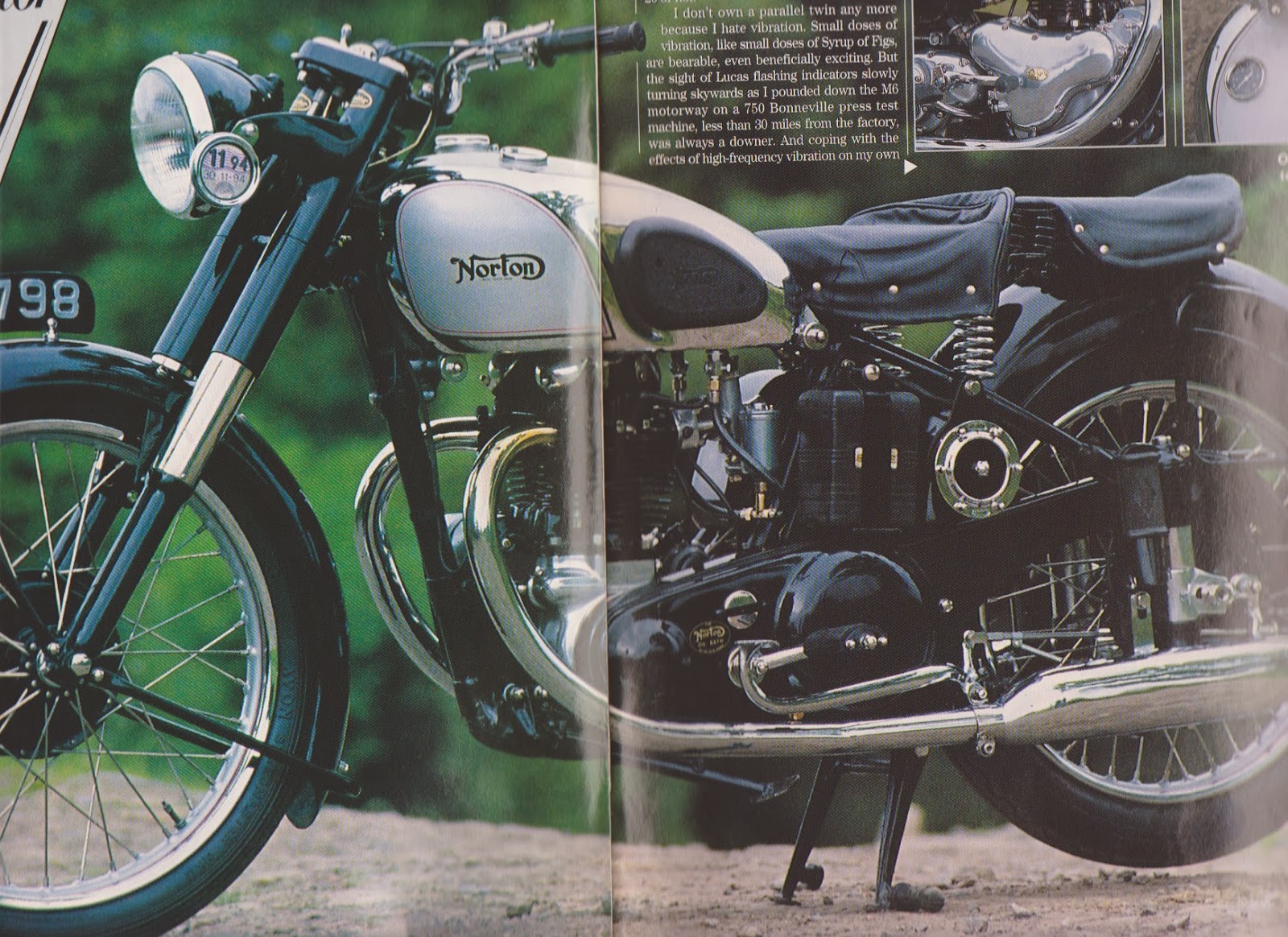
I am still gathering more information about Douglas motorcycles and browsing through magazines at the Museum last Monday discover an article about one of the bikes we do have in the Museum. The article in Classic Motorcycle of September 1994 describes the Norton as a good all round motorcycle with excellent handling and acceleration. It would out drag a Triumph but fail on top speed. That was Triumphs domain.  As a recent report on the Model 7 it was very favourable, with cast iron head and barrel as the norm of the time. It did not have the featherbed frame a little too early but did have the teledraulic forks. It has a classic style and reported to be Norton’s best twin.


The Norton is squeezed in between a Sunbeam and a Velocette and stands out with its silver tank in a sea of black. Behind it is the Ariel Square Four a monster of the time. In the same magazine was a feature on Val Page one of motorcycle design leading lights and his designs pop up with the major motorcycle producers from the Golden Age of British Motorcycles.


As for getting out and about I’ve been out to my monthly 2CV club meeting on the Monday evening and the LE club on the Tuesday only Pete has been handing out fliers and has left a bundle at Chiswick Honda for them to hand out. There are many dealers out there that are supporting us by just having our fliers around. I was in the Museum this Sunday for a flying visit and as I was leaving spoke to a man who was keen on two strokes so I spent a little time with him talking about the attributes of the 1925 Scott Flying Squirrel 600cc two stroke water cooled twin and what made that design special for the time but also restricted future developments.


 I have always liked the idea of the Scott with the removable transfer ports and the ease at which you could tune the engine. Everything is so easy to get at.  It was a good design in its day but developments with two and four stroke engines over the years meant it was left behind in the race for performance and sales in the 50’s.